Last week, we received our new 2016 shipment of Aquaglide Cascade inflatable paddle boards consisting of three models ranging in size from 10 to 12 feet.
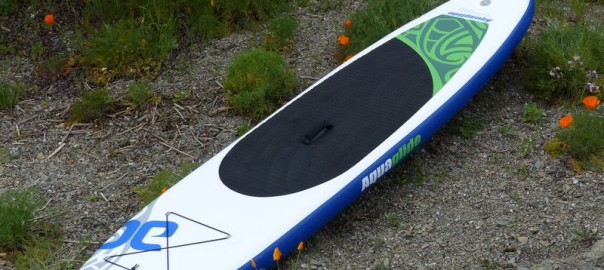
Last week, we received our new 2016 shipment of Aquaglide Cascade inflatable paddle boards consisting of three models ranging in size from 10 to 12 feet.
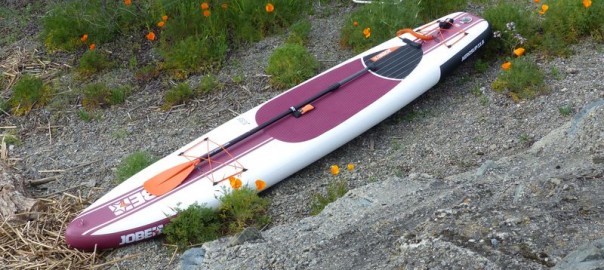
Last month we received the first of Jobe’s 2016 inflatable paddle board line. Well known in Europe for windsurf, water boards and attire, Jobe expanded into the inflatable paddle board line a few years ago. Since then, the line has evolved to encompass a cohesive look, epitomized by complete “paddle board packages” including paddle, pump, backpack, leash and board – pretty much everything needed to get on the water.
The 2016 inflatable Aero SUP line includes 6 models ranging in size from 9’4″ to 12’6″ covering the gamut from surf to yoga. The current boards also feature Jobe’s new technology – a heavy-duty, double-laminate material which is stronger and lighter, providing up to 35% weight savings over previous models; the 2016 models now hover around the 20 lb. mark.
Our first Jobe review features the Aero SUP 11-6 all-round, recreational touring model.
(Please note: some of the info will be repeated from prior writeups.)
Jobe Aero SUP 11-6 Inflatable SUP – Getting Started
The board as-arrived is 35 x 17 x 12 inches in the box.
Inside is the Aero SUP 11-6 body, backpack, repair kit, single action pump with pressure gauge, cinch belt, removable fin, adjustable fiberglass breakdown paddle, ankle leash and instructions. Once rolled up, the SUP board fits into the backpack, as well as breakdown paddle and pump – each of these attach to the outside of the backpack, but could also be stowed inside. The board itself weighs 22.5 lbs, while the paddle and pump are 2 lbs each – a total of 31.75 lbs in the pack. The boxed weight is 36 lbs. The package easily fits in the back of a small car.
For your first set up, remove the cinch strap and unroll the SUP body. Lay it out face up so that you can access the military valve.
The Aero SUP 11-6 utilizes one spring-loaded military valve for inflation. These are very simple to use and feature an inflate mode (spring plunger is UP) and a deflate mode (spring plunger is DOWN). By using your finger to gently push on the plunger, it can be moved to the inflate mode (air goes in and doesn’t come back out) and deflate mode (air goes in and comes back out). As a cautionary note, before you make the effort to inflate the board, PLEASE make sure the plunger is in the inflate position.
The Aero SUP paddle board system includes a high-pressure, 2000 cm3 single-action pump with a gauge – what we term the “tall barrel” as it pushes out less air, though takes a bit less effort to attain the higher pressures.
First, attach the gauge to the pump – the gauge attaches via a pin/slot system.
Next, attach the hose to the gauge.
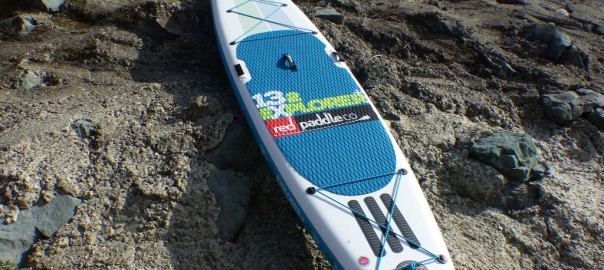
As mentioned in a prior post, we have been awaiting the arrival of the 2016 Red Paddle Co product line. The shipment recently arrived and we had our first opportunity to take a look at the new Red Air inflatable SUPS, consisting of 17 models. New for this year are three boards – the 8’10” Whip, the Explorer Plus 13’2″, and the Sport 12’6″.
Founded in 2007, Red Paddle Company is a UK-based business focused solely on the design and manufacture of inflatable paddle boards and accessories. Well-known for their ruggedness, each of the boards utilize high pressure drop-stitch technology – allowing them to be inflated from 16-22 PSI – and feature quadruple rail construction and double layering. The larger boards come with the Red Paddle Titan pump, a dual-barrel pump allowing one to inflate a paddle board in minutes.
For 2016, Red Paddle Co introduced a technological advance termed MSL (Monocoque Structural Laminate) fusion technology. The new process has resulted in boards that weight up to 10 lbs lighter than previous models, without sacrificing soundness or rigidity. Indeed, the 2016 slogan for Red Paddle is “stronger, stiffer, lighter.”
Our first write-up on the new boards focused on the Sport 12’6″ iSUP – a 30″ wide, sleek, inflatable cruising model reminiscent of the original Race 12’6″, constructed from thicker 150mm drop-stitch material and the revolutionary new rocker stiffening system (RSS).
Included in this shipment was all the new Explorer + 13’2″, a feature-rich, high-speed cruiser built as the ultimate exploration board. So, we opened the box and started getting ourselves acquainted with this intriguing new model. (Please note, some of the information here will be repeated from other writeups.)
Red Paddle Co Explorer Plus 13-2: Getting Started
The box as received weighs 41 lbs, measuring 37 x 15 x 15 inches.
Inside the box is the SUP body, two RSS side battens, Titan dual barrel pump, pressure gauge, backpack, cinch belt, removable fin, instructions and repair kit – as well as a bonus cell phone case. Once rolled up, the SUP board and paddle fit into the backpack, as well as optional breakdown paddles under 37 inches.
Weight is 37 lbs for backpack, board and pump, which all easily fit in the back of a small car. The board alone is approximately 24 lbs.
Red Paddle Co Thirteen Two Explorer Plus: Setup
The Red Paddle Co 13’2 Explorer Plus inflatable SUP arrives rolled up around the Titan pump, inside the backpack. Instructions are located inside the cell phone case, attached to the zipper pull on the bag.
For your first set up, remove and unroll the SUP body. Lay it out face up so that you can access the military valve.
The Explorer Plus 13-2 utilizes one spring-loaded military valve for inflation.
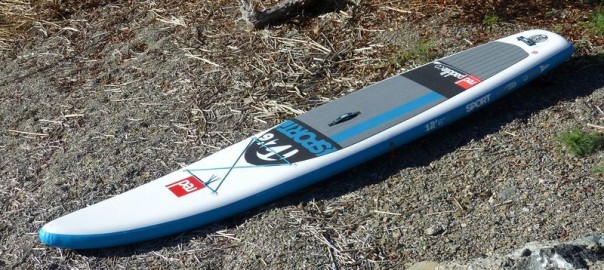
We have avidly been awaiting the arrival of the 2016 Red Paddle Co product line. Recently, the truck rolled in and we had our first opportunity to take a look at the new Red Air inflatable SUPS, consisting of 17 models. New for this year are three boards – the 8’10” Whip, the Explorer Plus 13’2″, and the Sport 12’6″.
Founded in 2007, Red Paddle Company is a UK-based business focused solely on the design and manufacture of inflatable paddle boards and accessories.
For 2016, Red Paddle Co has streamlined many of the current models, focusing on technology improvements; the mantra this year is “stronger, stiffer, lighter.” And indeed, the new product line is quite a bit lighter. The introduction of a technological advance termed MSL (Monocoque Structural Laminate) fusion technology has resulted in boards that weight up to 10 lbs lighter than previous models, without sacrificing soundness or rigidity.
Included in this shipment is the new Sport 12-6 ISUP – a 30-inch wide, sleek, inflatable cruising model reminiscent of the original Race 12’6″ – featuring 150mm drop-stitch material and the revolutionary new rocker stiffening system (RSS).
So we begin our first in the series on the new 2016 models, featuring the Sport 12-6. (Please note: Some of this will be repeated from previous write-ups.)
Red Paddle Co Sport 12-6: Getting Started
The box as received weighs 39.5 lbs, measuring 37 x 15 x 15 inches.
Inside the box is the SUP body, two RSS side battens, Titan dual-barrel pump, pressure gauge, backpack, cinch belt, removable fin, instructions and repair kit – as well as a bonus cell phone case. Once rolled up, the SUP board and paddle fit into the backpack, as well as optional breakdown paddles under 37 inches.
Weight is 35 lbs for backpack, board and pump, which all easily fit in the back of a small car. The board alone is approximately 23 lbs.
The Red Paddle Sport 12-6 inflatable SUP arrives rolled up around the high pressure Titan pump, inside the backpack.
Instructions are located inside the cell phone case, attached to the zipper pull on the bag.
For your first set up, remove and unroll the SUP body. Lay it out face up so that you can access the military valve.
The Red Air Sport 12-6 utilizes one spring-loaded military valve for inflation. These are very simple to use and feature a deflate mode (spring plunger is DOWN) and inflate mode (spring plunger is UP). By using your finger to push on the plunger, it can be moved to the inflate mode (air goes in and doesn’t come back out) and deflate mode (air goes in and comes back out). Before you go to all the effort of inflating the board, PLEASE make sure the plunger
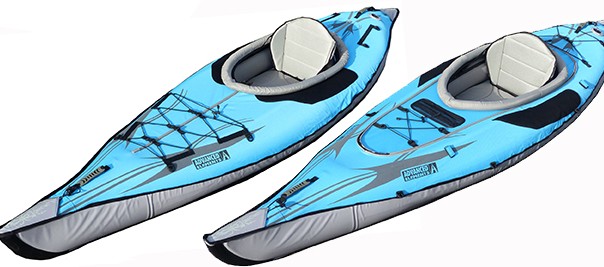
We continue with our reviews on the new Advanced Elements AE1044DS™ series of kayaks.
As previously mentioned, two years ago, AirKayaks introduced the specially-packaged, high-pressure AdvancedFrame DS series™ of kayaks from Advanced Elements. Featuring the same high quality construction and materials as the standard AE1012 AdvancedFrame and AE1007 Convertible, the DS Series™ was bundled with upgraded accessories to enhance performance and comfort.
This past year, AirKayaks worked with the designers at Advanced Elements, to introduce the next generation in the DS Series – the AdvancedFrame AE1044 DS-XL™* and DS-XLC™*.
The new DS-XL series is an elongated version of the classic AE1012 AdvancedFrame. With an additional 5 inches in length and an adjustable foot peg, the kayaks are comfortable enough for both taller and smaller paddlers. The longer, streamlined body – in conjunction with the high pressure floor – provides better tracking, higher payload capacity and increased glide with minimal increase in weight.
We grabbed two from the limited supply that initially arrived. Our first review focused on the AE1044 AdvancedFrame DS-XLC (Cover). The XLC kayak features a zip-on deck with storage options, allowing paddlers the flexibility of paddling an open style design for easy entry, or a closed deck design which can take an optional spray skirt.
We now turn to the AdvancedFrame AE1044DS-XL, a 10′ 10″ inflatable with fixed deck, weighing in at 35 lbs. in the carrying case. Please note, some of this information will be repeated from previous writeups.
AdvancedFrame DS-XL Setup/Inflatation
We unpacked the boxes and laid out the pieces – inflatable kayak, carrying case, instructions, repair kit, foot brace, double action pump with gauge, and high-back lumbar seat.
The kayak with seat, floor and brace weighs 35 lbs, or 39 lbs in the bag with the pump. Bag measurements are approximately 32 x 19 x 10 inches. The kayak box as arrived weighs 40 lbs, measuring 33 x 21 x 10 inches. The dropstitch (DS) floor weighs 5 lbs and comes in a second box with adaptor – the DS floor utilizes the same repair kit as included with the kayak.
(AirKayaks Side note #1: When initially removing the kayak from the carrying case, take a good look at how the kayak is folded. This is probably the most overlooked step and it is VERY helpful when trying to get the kayak back into the bag.)
Set up is straight-forward and simple – unpack, unfold, inflate. The DS XL Series will have two sets of instructions – one can be found in the inner side pocket of the carrying case. This details the basic kayak instructions for inflation, deflation and folding. A second set of instructions is included in the dropstitch floor repair kit package, and details the floor inflation. TIP: Attach the floor instructions
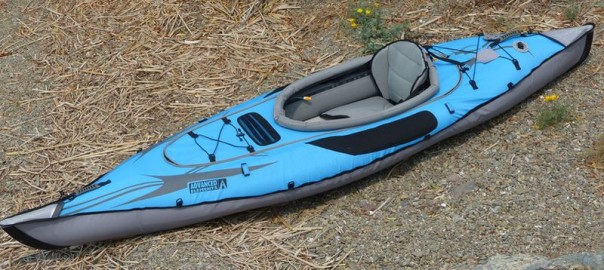
Two years ago, AirKayaks introduced the specially-packaged, high-pressure AdvancedFrame DS series of kayaks from Advanced Elements. Featuring the same high quality construction and materials as the standard AE1012 AdvancedFrame and AE1007 Convertible, the DS Series™ was bundled with upgraded accessories to enhance performance and comfort.
The upgrades included:
AEDS High-pressure inflatable 4-6 PSI dropstitch floor for extreme rigidity
AE2011 Double action high-pressure 14 PSI handpump with pressure-gauge
AE2013HB High-back lumbar seat(s) for the ultimate in a comfortable, adjustable back rest.
The kayaks were wildly popular, and this past week, AirKayaks introduced the next generation in the DS Series – the AdvancedFrame AE1044 DS-XL™* and DS-XLC™*.
The new DS-XL series is an elongated version of the classic AE1012 AdvancedFrame. With an additional 5 inches in length and an adjustable foot peg, the kayaks are comfortable enough for both taller and smaller paddlers. The longer, streamlined body – in conjunction with the high pressure floor – provides better tracking and increased glide with minimal increase in weight.
We grabbed two from the limited supply that recently arrived – more are available in mid-September. Our first review focuses on the AE1044 AdvancedFrame DS-XLC (Cover). This kayak features a zip-on deck with storage options, allowing paddlers the flexibility of paddling an open style design for easy entry, or a closed deck design which can take an optional spray skirt.
So here are details on the AdvancedFrame AE1044 DS-XLC, a 10′ 10″ inflatable with zip-in cover, weighing in at 35 lbs. in the carrying case.
Setup/Inflatation
We unpacked the box and laid out the pieces – inflatable kayak, carrying case, instructions, repair kit, foot brace, double action pump with gauge, zip-on deck (installed on the kayak) and high-back lumbar seat. The kayak with seat, floor and brace weighs 35 lbs, or 39 lbs in the bag with the pump. Bag measurements are approximately 32 x 19 x 10 inches. The kayak box as arrived weighs 40 lbs, measuring 33 x 21 x 10 inches. The dropstitch (DS) floor weighs 5 lbs and comes in a second box with adaptor and repair kit.
(AirKayaks Side note #1: When initially removing the kayak from the carrying case, take a good look at how the kayak is folded. This is probably the most overlooked step and it is VERY helpful when trying to get the kayak back into the bag.)
Set up is straight-forward and simple – unpack, unfold, inflate. As this is similar to the standard AdvancedFrame in many respects, we will re-copy much of the instructions found in the writeup on the standard AE1012. The DS XL Series will have two sets of instructions – one can be found in the inner side pocket of the carrying case. This details the basic kayak instructions for inflation, deflation and
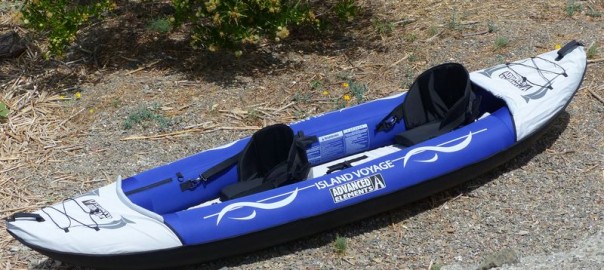
This week we received our first shipment of the Island Voyage 2 inflatable kayak from Advanced Elements. New in 2015, the Island Voyage 2 is a recreational model with an open-design – allowing one to easily switch from single to tandem paddling – yet economically-priced at $399.
Following is our writeup on the Island Voyage 2, an 11 ft 2 inch kayak. Please note, some of this will be repeated from prior write-ups.
Getting Started with the Island Voyage 2
We unpacked the box and laid out the pieces – inflatable kayak, drawstring duffel bag, instructions, repair kit, tracking fin and two seats.
Initial measurements showed the kayak body weighs 25 lbs while the kayak with seats in the duffle is 30 lbs. The drawstring case is roughly 37 x 28 inches. Boxed up, the dimensions are 25 x 19 x 14 inches inches with a shipping weight of 35 lbs.
(AirKayaks Side note #1: When initially removing the kayak from the carrying case, take a good look at how the kayak is folded This is probably the most overlooked step and it is VERY helpful when trying to get the kayak back into the bag.)
Island Voyage 2 Inflatation and Setup
The included instructions appear adequate and include diagrams with inflation details.
Set up is straight-forward and simple – unpack, unfold, inflate.
The first step is to attach the removable tracking fin, which enhances paddling/tracking in deeper water. Make sure the fin is pointing towards the rear of the kayak, then insert the front of the fin, pushing down and back, to lock the front end. Then move the fin back until the holes line up, and replace the retaining pin. At this point, pull up on the fin to make sure you have it locked in position. AirKayaks side note #2: You may want to bring along a towel, as the fin and bottom hull of the kayak are black, and become quite burning in the sun.
There are three inflation chambers utilizing Boston valves – the floor and two side chambers. Boston valves are two-part, screw-on valves. The bottom portion is threaded onto the kayak, the top valve is screwed open for inflation and then tightened shut after inflation. Air is easily released by unscrewing the base connector. How does it work? A flap inside the valve opens when air is pumped into the kayak, and falls shut when not pumped so that air will not rush back out.
(AirKayaks Side note #3: The Boston valves have a tether that keeps the valve attached to the kayak, ensuring that the valves don’t get lost after deflating. Make sure this does not get in the way when screwing on the valve base, and the valve is not cross-threaded, or

This year we had our first hands-on experience with Mistral’s inflatable SUP line. Well-known for decades as a leader in windsurfing, the Mistral line originated in northwest US, but is now based out of Europe. Most recently, Mistral has forayed back into the US market, bringing their expanding inflatable SUP line.
This winter, Mistral introduced the Crossover and Equipe inflatable SUP line to the US, remarkable for its weight – or should we should say – lack of. Manufactured in Romania, the new SUPs from Mistral utilize a futuristic German material that is REACH-certified and environmentally-friendly, combining light weight with extreme stiffness. In fact, the Crossover line (shown above) starts at 16 lbs, reaching a high of 18 lbs with the 12-5 Equipe.
We first wrote up the Mistral Kailua inflatable paddle board , part of their standard line and an 11-5 foot SUP touted as a fitness board, but also a great all-round paddle board and sit-on-top. This was followed by the Mistral Adventure 11-5 inflatable SUP.
Now we check out the Mistral Equipe 12-5 inflatable paddle board, weighing in at a minimalist 18 lbs. (Please note: some of the info will be repeated from prior writeups.)
Mistral Equipe 12-5 Inflatable WindSUP – Getting Started
The board as-arrived is 33 x 17 x 13 inches in the box, which weighs 27.8 lbs.
Inside is the Equipe 12-5 body, backpack, repair kit with Gorilla glue, single action Bravo pump with pressure gauge, a removable fin, valve wrench and instructions. Once rolled up, the SUP board fits into the backpack, as well as breakdown paddles under 36 in length; the pump fits in the large front pocket or the bag. The board itself weighs 17.2 lbs, or 24.2 lbs inside the backpack with pump and other accessories – these all easily fit in the back of a small car.
For your first set up, remove the SUP body from the backpack, and unroll. Lay it out face up so that you can access the military valve.
The Equipe 12-5 utilizes one spring-loaded military valve for inflation. These are very simple to use and feature an inflate mode (spring plunger is UP) and a deflate mode (spring plunger is DOWN). By using your finger to gently push on the plunger, it can be moved to the inflate mode (air goes in and doesn’t come back out) and deflate mode (air goes in and comes back out). Not to worry, the instructions are printed on the valve. But before you make the effort to inflate the board, PLEASE make sure the plunger is in the inflate position.
The Equipe paddle board system includes a Bravo high-pressure, single-action pump with a gauge – what we term the “wide barrel” as it pushes out
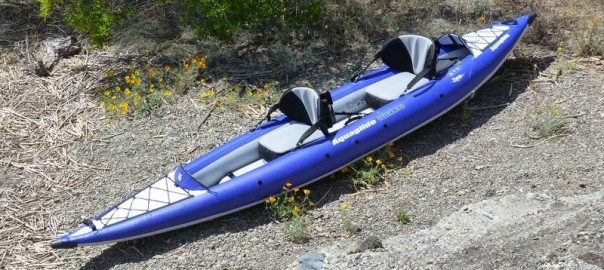
Last summer, AquaGlide unveiled their new inflatable kayak lineup for 2015, which included a series of new models and revamps. Based on the number of inquiries, we were anxious to try out the new Chelan HB high-pressure series.
The new models arrived earlier this year, and we started inflating and testing, beginning with the Chelan HB Tandem XL and Chelan HB One. This was followed by the Columbia XP Tandem XL, Chinook One and Panther.
Our sixth 2015 review focuses on the Chelan HB Two, a 13.5 foot long inflatable kayak designed for one or two paddlers. At this time, we will point out that the AquaGlide kayak models are named after rivers in Washington State, and the river is pronounced “shuh-LAN.”
(Please note: some of the information will be repeated from other writeups.)
Getting Started with the Aquaglide Chelan HB Two:
We unpacked the box and laid out the pieces – inflatable kayak, backpack, instructions, repair kit, foot braces, tracking fin, two seats, valve adaptor and two pieces of plastic.
Initial measurements showed the kayak body weighs approximately 27 lbs, with a backpack size of roughly 27 x 22 x 18 inches, while the kayak with seats, fin and braces – all in the backpack – weighs 38.5 lbs. Boxed up, the dimensions are 26 x 25 x 12 inches with a shipping weight of 46 lbs.
(AirKayaks Side note #1: When initially removing the kayak from the carrying case, take a good look at how the kayak is folded. This is probably the most overlooked step and it is VERY helpful when trying to get the kayak back into the bag.)
The included instructions appeared adequate and include diagrams with inflation details.
Set up is straight-forward and simple – unpack, unfold, inflate.
There are three military valves (both sides and the floor) with two more small chambers utilizing twistlock valves for the seat bases – the floor is pumped up first, to 6 PSI.
The floor is held in place with two adjustable straps. From our prior experience, we found it best to loosen up the straps, otherwise the floor could be inflated “lopsided.”
The military-style plunger valve is simple to use – with your finger, twist the plunger slightly to the “up” position to inflate (air goes in but doesn’t come back out) and “down” to deflate (air comes out).
The Chelan HB Two military valves require a special adaptor, which does not come with most standard pumps. In Aquaglide’s first year, the military adaptors were not included with the high-pressure kayaks, which caused problems. All the 2015 high pressure models now include the adaptor, which is found in the repair kit.
The Aquaglide military adaptor couples to the valve with a Boston valve adaptor; this is a common fitting, slightly
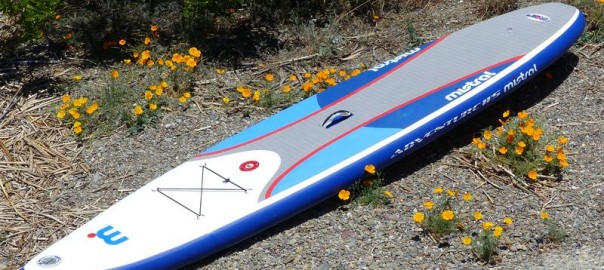
This year, we had our first hands-on experience with Mistral’s inflatable SUP line. Well-known for decades as a leader in windsurfing, the Mistral line originated in northwest US, but is now based out of Europe. Most recently, Mistral has forayed back into the US market, bringing their expanding inflatable SUP lines built in both Europe and Asia.
Our first two Mistral reviews focus on the Asian-produced boards, beginning with the Mistral Kailua inflatable paddle board – an 11 foot SUP touted as a fitness board, but also a great standup paddle board and sit-on-top.
Now we check out the Mistral Adventure inflatable SUP, an all-round cruiser designed for a wide range of conditions from flatwater lakes to oceans and rivers. The Adventure comes in two sizes – the Adventure 10-5 and Adventure 11-6. For this review, we chose the Adventure 11-6 inflatable SUP.
(Please note: some of the info will be repeated from prior writeups.)
Mistral Adventure 11’5 Inflatable Standup Paddle Board – Getting Started
The board as-arrived is 34 x 19.5 x 11 inches in the box, weighing in at 38 lbs.
Inside is the Adventure body, backpack, repair kit, single action pump with pressure gauge, removable fin and instructions (inside front zippered pocket). Once rolled up, the SUP board fits into the backpack, as well as a breakdown paddle under 35 inches (longest shaft length) – if an excellent packer, the pump will fit inside too, or it can be attached to the outside of the bag. The board itself weighs 27 lbs, or 33 lbs inside the backpack with pump – these all easily fit in the back of a small car.
For your first set up, remove the SUP body from the backpack, and unroll. Lay it out face up so that you can access the military valve.
The Adventure 11-5 utilizes one spring-loaded military valve for inflation. These are very simple to use and feature an inflate mode (spring plunger is UP) and a deflate mode (spring plunger is DOWN). By using your finger to gently push on the plunger, it can be moved to the inflate mode (air goes in and doesn’t come back out) and deflate mode (air goes in and comes back out) – before you make the effort to inflate the board, PLEASE make sure the plunger is in the inflate position.
The Adventure paddle board system includes a high-pressure, single-action pump with a gauge – what we term the “slim barrel” as it pushes out a bit less air, making it easier to attain very high pressures. Recommended board pressure is 15 PSI.
First, hook the gauge onto the pump then attach the hose to the gauge. Push and twist the military valve adaptor onto the valve, and lock into
You must be logged in to post a comment.